You know the feeling when an image stays with you long after you have closed the page. Not because it matches a trend, but because something in it feels familiar, stirring, quietly alive. That is usually the best place to begin when learning how to buy art prints – not with pressure, but with connection.
A good print can hold far more than a picture. It can carry a memory of travel, a love of wild places, a fascination with color, or a sense of peace you want to return to every day. Buying one is not about proving you know the art world. It is about choosing a work you want to keep company with.
How to buy art prints without feeling overwhelmed
Many people assume buying art prints requires expert knowledge. It does not. What it does require is a little attention. The difference between a print you enjoy for years and one you regret is often not price. It is whether you understood what you were buying and why it mattered to you.
Start with the artwork itself. Before you think about size, paper, or framing, ask a simpler question: would you still want this image if no one else saw it? Art prints are most satisfying when they feel personal. If you are buying only to fill a blank space or imitate a mood you have seen elsewhere, the connection can fade quickly.
Then look at the artist behind the work. Prints become more meaningful when you understand the voice that created them. Some artists work from lived experiences – travel, wildlife encounters, human stories, landscapes, or cultural memory. Others focus on purely formal qualities like rhythm, gesture, and abstraction. Neither is better. It depends on what you are drawn to. But knowing the source of the work helps you buy with intention instead of impulse.
Understand what kind of print you are buying
This is where confidence grows. Not every art print is the same, and the language can feel confusing at first.
An open edition print can be reproduced without a fixed limit. These are often more accessible in price and can be a beautiful way to begin collecting. A limited edition print is produced in a set quantity, often numbered and sometimes signed. Because fewer exist, they can feel more collectible, though scarcity alone does not make a work better.
You may also see terms related to process. A giclee print usually refers to a high-quality inkjet print made with archival inks on fine art paper or canvas. The value here is not the French-sounding name. The value is in color accuracy, longevity, and material quality. Other print methods, such as screen printing or etching, involve more hands-on processes and may show more texture or variation. If process matters to you, ask.
There is no single right choice between open edition and limited edition, or between paper and canvas. If you want an accessible way to live with work you love, an open edition may be exactly right. If you care about rarity or want something that feels closer to a collector purchase, a limited edition may suit you better.
Look closely at materials, not just the image
A strong image printed poorly can lose its presence. This is why materials matter.
When buying a print on paper, pay attention to whether the paper is archival and acid-free. These qualities help the print age well rather than yellowing or becoming brittle. Cotton rag and other fine art papers often have a softness and depth that elevate the image. Some papers create a velvety, matte feeling. Others bring more crispness or brightness. The best choice depends on the artwork itself.
If the print is on canvas, ask whether it is stretched or rolled, and whether the inks are archival. Canvas can create a painterly presence, especially when the original work began as a painting. Paper, on the other hand, can reveal delicate detail beautifully.
If a seller does not provide any information about materials, that is worth noticing. You do not need a technical lecture, but you should be able to learn the essentials: print method, substrate, edition details if relevant, and whether the materials are designed to last.
Size changes the experience
One of the most common mistakes people make when figuring out how to buy art prints is choosing size too quickly.
A print you love on a screen can feel entirely different at 8 x 10 than it does at 24 x 36. Small works invite intimacy. You move closer. You discover detail slowly. Larger works create immersion and emotional impact, but only if the image can hold that scale.
This is why it helps to ask yourself how you want to encounter the piece. Do you want a quiet, personal moment with it, or do you want the image to have a stronger physical presence? Neither answer is more refined. They simply create different relationships.
When dimensions are listed, pay attention to whether they describe the image size or the full paper size. Borders can be generous on fine art prints, and that affects the final presentation. If you are unsure, ask for clarity before buying.
Color online is never perfect
Art is one of the hardest things to judge through a screen. A print may appear warmer, cooler, darker, or more saturated in person than it does on your phone or laptop. That does not mean online buying is risky by default, but it does mean you should approach color with some humility.
If color is crucial to your decision, view the image on more than one device. Read the description carefully. Artists and galleries who care about the buying experience usually offer language that helps you imagine the work honestly rather than overselling it.
It also helps to look for close-up images. These often reveal texture, line quality, and tonal subtlety that a distant product photo cannot show. If all you see is one polished mockup, you may not have enough information.
Ask the questions that actually matter
You do not need to ask many questions. Just the right ones.
Ask whether the print is archival. Ask whether it is signed or numbered if that matters to you. Ask what kind of paper or canvas is used. Ask how closely the print reflects the original artwork. Ask about turnaround time and packaging, especially if you are ordering internationally or buying as a gift.
A thoughtful seller should welcome these questions. Buying art is personal, and trust is part of the experience.
Price is about more than size
People often compare art prints by dimensions alone, but price reflects more than width and height. It may include edition size, printing method, material quality, artist reputation, packaging, and the level of care in the production process.
A very inexpensive print is not automatically a bad choice. It may simply be a more open and accessible format. But if two prints seem similar and one costs much more, there is usually a reason worth understanding.
The deeper question is not whether a print is cheap or expensive. It is whether it feels honest in relation to what you are receiving. Art buying becomes much easier when you stop chasing the perfect deal and start looking for real value.
Buy from places that feel human
There is a difference between buying an image and buying a work of art. The difference is often the relationship around it.
When the artist or seller shares the story behind the work, explains the materials clearly, and presents the print with care, the experience feels more grounded. You understand what you are welcoming into your life. This is especially true if you are drawn to art that comes from lived experience – a journey through rainforest light, a memory of an animal encounter, a portrait shaped by tenderness, or a landscape carrying emotional truth.
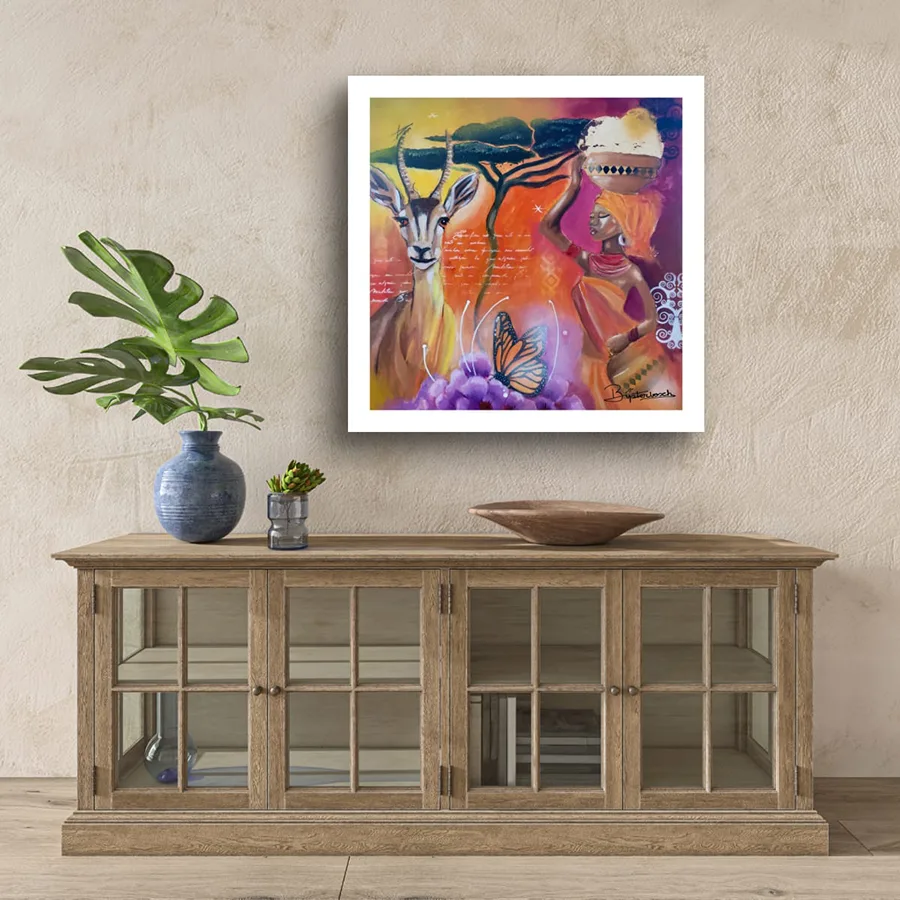
That sense of human presence matters. At Bijsterbosch Art, for example, prints are part of a larger artistic world shaped by travel, nature, cultural wonder, and the belief that art can bring courage and quiet joy into daily life. You feel when a print comes from that kind of sincere source.
Trust your response, then give it one more look
If a print moves you, pause before you buy it. Not to talk yourself out of it, but to test the feeling. Return to it the next day. See whether the connection deepens or disappears.
The right print usually has a kind of steadiness. It keeps calling you back. Not loudly, but clearly. You do not need to justify that response with art jargon or collecting strategy.
Learning how to buy art prints is really about learning how to recognize that steady pull, then matching it with practical clarity. Know the materials. Understand the edition. Ask about the process. Take color and size seriously. But leave room for wonder too.
The most meaningful print is rarely the one that makes the strongest first impression for everyone else. It is the one that continues to speak to something true in you, long after the moment of choosing has passed.