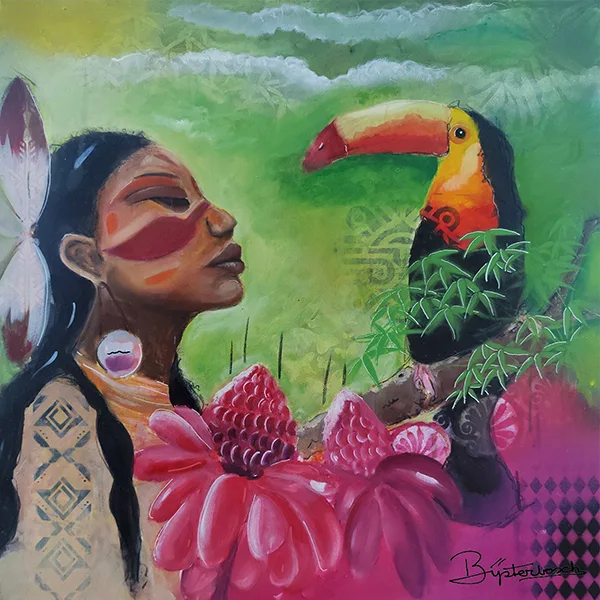
The first sound that changes you is not always the howler monkey or the rain on giant leaves. Sometimes it is the sudden quiet in your own mind when you stop looking at a screen, stop rushing, and begin to really see. That is what a Costa Rica jungle painting retreat can offer – not just a trip or a workshop, but a return to your senses.
For artists, nature lovers, and travelers who feel most alive when beauty is wild and unpolished, painting in the jungle is a very different experience from painting in a studio. The light is moving. The air is thick with life. Color does not sit politely in front of you. It pulses, disappears, and returns in another form. Green is never just green. Shadow carries blue, gold, and deep volcanic brown. A bird call can interrupt a sketch and somehow make it better.
This kind of retreat is not about producing perfect work. It is about making honest work. The jungle asks for presence, and presence changes what comes out of your hand.
What makes a Costa Rica jungle painting retreat so different
A painting retreat in a city or a traditional art center often gives you structure, comfort, and controlled subjects. A Costa Rica jungle painting retreat gives you something less predictable and often more transformative. You are surrounded by movement, humidity, insects, birds, shifting weather, and the emotional charge of being somewhere very alive.
That matters because creativity does not only respond to skill. It responds to environment. When your nervous system wakes up, your perception sharpens. You notice texture more deeply. You become more intuitive with color. You may loosen your style, not because you planned to, but because the landscape refuses to be captured in a stiff way.
There is also a deeper emotional layer. In the jungle, you are constantly reminded that you are part of something larger. For many artists, that feeling opens a different kind of work – less polished, perhaps, but more soulful. More courageous. More true.
Still, it depends on what you want. If you need perfect climate control, exact schedules, and clean studio conditions, a jungle retreat may feel demanding. But if you are longing for creative renewal, sensory richness, and a stronger connection between art and life, this setting can be extraordinary.
Who this experience is really for
Not everyone joins a retreat for the same reason. Some come because they want to improve technically. Some want to break through creative fear. Others are experienced artists who simply need a new landscape to awaken their work again.
A Costa Rica jungle painting retreat tends to suit people who are open to process. You do not need to be a full-time painter. You do need curiosity, flexibility, and a willingness to create in changing conditions. If you are attached to control, the jungle will challenge you. If you are ready to respond rather than dominate, it will teach you.
This experience can be especially meaningful for artists who care about wildlife, biodiversity, and the relationship between beauty and responsibility. When painting is connected to conservation or local environmental support, the work carries another kind of weight. It is no longer only personal expression. It becomes a gesture of witness and care.
What a retreat like this can feel like day to day
Most people imagine nonstop painting, but the rhythm is usually gentler and more layered than that. A meaningful retreat balances making, observing, resting, and absorbing. Early morning might bring sketching while the air is still cool and birds are most active. Midday may become a time for reflection, discussion, or working from studies in shade. Late afternoon often offers another opening when the light softens and the jungle shifts again.
You may work quickly outdoors and then develop paintings later. You may fill pages with color notes, leaf forms, animal gestures, and fragments of atmosphere rather than complete finished pieces. That is not a lesser outcome. In many cases, those fragments become the seed of stronger work once you return home.
There is usually a communal side too. Sharing meals, speaking about what moved you, and seeing how different artists respond to the same landscape can be deeply nourishing. One person notices structure. Another sees emotion. Another paints rhythm. You begin to understand that art is not only about what is in front of you, but what within you recognizes it.
The real creative challenge of painting in the jungle
The jungle is generous, but it is not easy. Light changes fast. Paper warps. Paint behaves differently in humidity. Wildlife rarely poses for long. You may feel overstimulated at first, even unsure where to begin.
That is part of the value.
A jungle environment asks you to let go of overworking and overthinking. You have to simplify. You have to choose. You learn to capture energy before detail. Gesture before finish. Atmosphere before explanation. For many artists, this becomes a breakthrough.
There are practical adjustments that help. Smaller formats are often easier outdoors. Fast studies can be more useful than ambitious compositions on site. Limited palettes tend to bring clarity when the landscape offers too much information. And sometimes the best painting practice is not painting at all for an hour, but sitting still enough to understand the character of a place.
Why purpose matters in a Costa Rica jungle painting retreat
There is something powerful about creating art in a place of immense natural beauty while also recognizing its fragility. Costa Rica is often admired for its rich biodiversity, but admiration alone does not protect forests, animals, or local communities. Purpose changes the atmosphere of a retreat.
When artists gather to make work that supports conservation, education, or biodiversity-focused organizations, painting becomes more than observation. It becomes relationship. You are not just taking inspiration from the jungle. You are participating in a cycle of giving back.
That does not make the art heavier in a negative sense. If anything, it can make the experience more joyful and more honest. Beauty is felt more deeply when it is tied to care. For some traveling artists, this is the missing piece. They do not only want a beautiful setting. They want their presence to mean something.
This is part of what makes artist-led art weeks so compelling when they are built with sincerity. In the work of Bernadet Bijsterbosch, travel, painting, and support for biodiversity are not separate ideas. They belong to the same creative heartbeat.
How to know if a retreat is the right fit
Before you book any painting retreat, it helps to ask better questions than simply, Where is it and how much does it cost? A more meaningful question is, What kind of artist will this environment ask me to become?
Look at the pace. Some retreats are intensive and skill-driven. Others are immersive and intuitive. Consider the balance between guidance and independence. Think about whether you want close mentorship, shared exploration, or more solitude.
Also pay attention to values. If the retreat speaks about nature only as scenery, that creates one kind of experience. If it honors the local ecosystem, works with nonprofit partners, or invites artists into a deeper awareness of place, that creates another. Neither is automatically wrong, but they are not the same.
It is also wise to be honest about comfort. Jungle travel may involve heat, insects, muddy paths, and less predictability than a European art holiday. For some people, that is part of the magic. For others, it may be distracting enough to limit creativity. Knowing your threshold is not weakness. It is wisdom.
What you may bring home that is not a painting
The visible outcome of a retreat is often a stack of sketches, studies, and canvases. But the invisible outcome is usually more important.
You may return with a different relationship to color. A more instinctive hand. A deeper trust in unfinished work. You may feel braver about painting movement, weather, or emotion. You may become less interested in making something pretty and more interested in making something alive.
Many artists also come back with renewed clarity about why they create at all. Daily life can make art feel fragmented, squeezed into the edges. A retreat in the jungle can restore the original pulse of it – the wonder, the urgency, the act of paying attention with love.
And perhaps that is the real gift. Not escape, but remembrance.
If the idea of painting in Costa Rica stirs something in you, listen to that stirring. Sometimes the places that feel a little wild are the ones that return us most fully to ourselves.