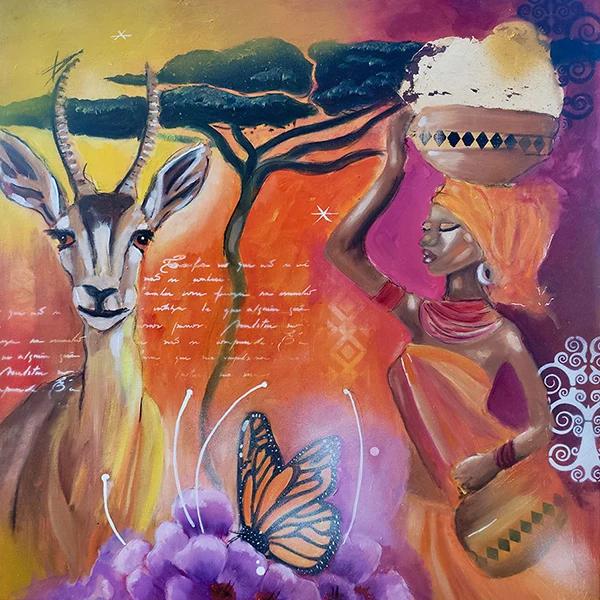
Some journeys stay in the body long after the suitcase is unpacked. A certain ochre road, the rhythm of market voices at dusk, the watchful stillness of a lemur in the trees – these experiences do not always return as clear memories. Often, they return as color, texture, gesture, and feeling. That is where a guide to travel inspired paintings begins: not with perfect documentation, but with the quiet moment when a place starts speaking through paint.
Travel-inspired art has a special power because it carries two kinds of truth at once. It holds the outer world – landscapes, wildlife, people, architecture, weather – and it holds the inner world of the artist who moved through that place. The strongest paintings are rarely postcards. They are emotional translations. They let wonder, discomfort, beauty, contradiction, and reverence live on the surface together.
What travel inspired paintings really capture
A travel-inspired painting is not simply a scene from another country or a recognizable landmark. It is a record of relationship. The artist has stood somewhere unfamiliar, paid attention, and been changed by that encounter.
That change can appear in different ways. Sometimes it shows up as vivid detail, like the layered greens of a rainforest or the pattern of woven cloth seen in a village. Sometimes it appears through atmosphere instead, where the place dissolves into bold color fields, fragments, or abstract marks. Neither approach is more true than the other. It depends on what the journey gave you.
This is one of the most beautiful tensions in travel-inspired work. If you paint every detail exactly, you may lose the pulse of the experience. If you lean too far into mood, the sense of place can disappear. The art often becomes most alive when memory and observation are allowed to meet halfway.
A guide to travel inspired paintings starts with attention
Before painting begins, there is a quieter practice that matters just as much: learning how to notice. Many artists travel with the pressure to gather material, produce strong work, or come home with something impressive. But the deeper source of meaningful art is attention, not performance.
Look at how light behaves in a place. Desert light has a different honesty than jungle light. Coastal air softens edges. Mountain weather sharpens them. Notice the colors that appear where you did not expect them. Black feathers may hold blue and green. Dust may glow pink at sunset. Skin, stone, leaves, and water all shift with the hour.
Listen, too. Sound changes how a place enters the painting. A silent forest creates a different visual language than a crowded harbor or a ceremonial gathering. Even scent and temperature can influence your palette and brushwork later. The body remembers more than the camera does.
This is why sketchbooks, handwritten notes, and loose color studies are often more valuable than a folder full of photos. A photograph can preserve information. A sketch can preserve presence.
From reference to resonance
One of the biggest questions artists face is whether to paint directly from life, from memory, or from photographs gathered during travel. The honest answer is that each has strengths and limitations.
Painting on location can bring urgency and truth. Your hand responds to changing weather, moving animals, shifting shadows, and the emotional immediacy of being there. The trade-off is that field conditions are rarely calm or comfortable. You may have little time, limited materials, or constant distractions.
Working later in the studio allows reflection. You can sort through impressions and find the deeper thread in what you experienced. The risk is that the work can become overly controlled or too dependent on photographic accuracy.
Memory-based painting often creates the most poetic results because memory naturally edits. It keeps what mattered and lets the rest fall away. But memory can also flatten specifics if you wait too long.
For many artists, the richest path is a conversation between all three. A few direct sketches, a handful of color notes, selected photographs, and time to reflect can lead to paintings that feel both grounded and alive.
Choosing what deserves to become a painting
Not every beautiful place becomes a meaningful artwork. Sometimes what is visually striking in the moment does not carry enough emotional weight later. At other times, a small encounter becomes the heart of an entire series.
When choosing a subject, ask what stayed with you. Was it the layered movement of tropical foliage? The dignity in a person’s posture? The intensity of animal eyes meeting yours for one suspended second? The geometry of fishing boats against pale water? The answer reveals more than composition. It reveals the real center of your experience.
Travel inspired paintings gain depth when the artist moves beyond the obvious. A famous skyline may be less compelling than a roadside shrine, a trail of footprints, or the pattern left by rain on red earth. These quieter subjects often hold more intimacy. They invite the viewer into a lived moment instead of a familiar image.
This is especially true when painting cultures and communities. Respect matters. If your work draws from people, traditions, or ceremonies encountered during travel, approach them with humility. Ask yourself whether you are honoring what you witnessed or simply extracting what looks visually exotic. The difference is felt in the work.
Color is often the first language of travel
Long after details blur, color remains. It is usually the fastest route back into a place. A humid green can carry an entire forest. Burnt sienna and indigo can hold an evening street. Turquoise against dry earth can recall both distance and heat.
In travel-inspired painting, color does more than describe. It remembers. It can express climate, emotion, cultural energy, and spiritual atmosphere all at once. This is why artists often find their palette shifting dramatically after travel. A new place can interrupt old habits and invite fresh courage.
That said, using brighter or more dramatic color is not automatically more truthful. Some places ask for restraint. Fog, stone, ash, and muted water have their own poetry. The goal is not spectacle. The goal is resonance.
If you are building a series, let the palette create continuity. Even when subjects vary, a shared temperature or recurring color relationship can make the body of work feel like one journey unfolding through many moments.
Let place shape the mark-making
Brushwork, layering, line, and texture are often overlooked in conversations about travel-inspired art, yet they carry enormous emotional force. The way paint moves can echo the nature of a place.
Dense, tangled mark-making may reflect the complexity of jungle growth. Broad quiet passages can evoke desert stillness. Repeated rhythmic lines may hold the energy of woven traditions, migration, current, or wind. Thick paint can give physical presence to rock, bark, and earth. Transparent washes can suggest heat, mist, memory, or distance.
This is where travel can expand an artist’s visual language. New environments ask different things from the hand. They challenge familiar habits. They ask for risk. Sometimes the most honest response to a place is not greater precision, but greater freedom.
Story gives the work a longer life
A strong travel-inspired painting can stand on visual power alone, but story gives it a longer emotional life. This does not mean overexplaining the work. It means knowing what moved you and allowing that truth to remain near the surface.
Perhaps the painting began after walking through a forest protected by people who know every medicinal plant by touch. Perhaps it came from seeing wildlife not as symbol, but as presence. Perhaps it grew from witnessing beauty that exists under pressure – ecosystems under threat, traditions held with courage, communities carrying ancestral knowledge forward.
When story is rooted in real encounter, the painting becomes more than a memory of movement. It becomes a form of witness.
That is part of what makes this practice so meaningful. Travel changes the artist, and the painting carries that change outward. At its best, it can deepen care for a place rather than consume it.
Why travel inspired paintings matter now
We live in a time when many places are photographed endlessly and understood very little. Painting offers a slower response. It asks for presence, interpretation, and feeling. It resists speed.
For artists drawn to nature, wildlife, cultural heritage, and the fragile beauty of the living world, travel-inspired painting can also become an act of connection and responsibility. It can remind us that beauty is not separate from protection. To truly see a landscape, species, or community is to feel some measure of care for its future.
This is where purpose can quietly enter the creative process. Not as a slogan, and not as decoration for a moral message, but as a deeper form of attention. The painting says: I was here, I witnessed this, and it matters.
If you are creating your own work, let the place stay complex. Let wonder sit beside unease. Let beauty remain wild. Let memory soften some edges and sharpen others. A journey does not need to be painted exactly as it looked to be painted truthfully.
Sometimes the most generous thing a painting can do is keep a place alive inside us a little longer – not as a destination checked off, but as a relationship that continues.