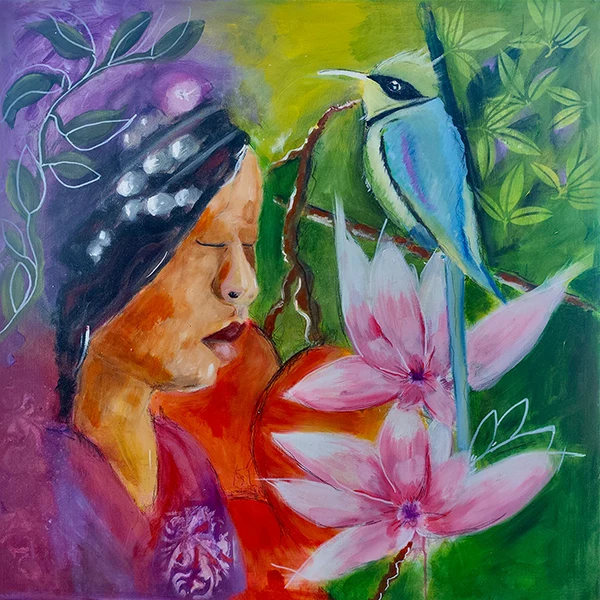
A jungle is never simply green. Stand before dense tropical foliage and you will find blue-green shadows, leaves warmed by yellow light, bruised violets at the edge of darkness, and sudden flashes of coral, lime, or deep red. The secret of how to paint jungle foliage is not to record every leaf. It is to paint the feeling of being surrounded by life.
Jungle scenes can intimidate even experienced artists because there is so much to see. Vines cross branches, leaves overlap leaves, and every surface seems to have its own pattern. Yet that abundance is also your invitation to paint with freedom. Begin by seeing the jungle as a rhythm of large shapes, changing light, and expressive color rather than a puzzle of botanical details.
Begin With the Atmosphere, Not the Leaves
Before you paint a single leaf, decide what it feels like to enter your scene. Is the air misty and quiet after rain? Is sunlight cutting through the canopy in bright, golden fragments? Is the jungle intimate, tangled, and close, or open enough to reveal a distant river, bird, or figure?
This emotional decision guides every practical choice that follows. A humid, shadowed forest may begin with deep ultramarine, sap green, burnt umber, and touches of violet. A sunlit tropical garden may call for warmer greens, cadmium yellow, turquoise, and a few passages of glowing orange or pink.
Make a small value study first, using only three to five tones. Keep it loose. The purpose is to establish where the deepest darks, middle values, and brightest lights will live. When the values are clear, even a wild palette can hold together.
Let dark space do some of the painting
One of the most convincing ways to create depth is to protect areas of darkness. In a real jungle, the eye cannot separate every leaf in the understory. Let clusters of leaves disappear into a rich, quiet background instead of outlining them all.
Dark passages are not empty. Mix them with color. A near-black made from ultramarine and burnt sienna feels more alive than black straight from the tube. Add a little green, violet, or crimson depending on the atmosphere you want. These layered shadows give bright leaves a place to breathe.
How to Paint Jungle Foliage in Layers
The most natural approach is to work from broad forms to selective detail. Think of the painting as a journey inward: distant canopy first, middle layers next, and the closest leaves last.
Block in the background with a large brush and varied greens. Avoid filling the entire canvas with one green mixture. Shift the temperature as you work: cooler blue-greens can recede, while yellow-greens often feel closer or catch more light. These are tendencies, not fixed rules. A cool turquoise leaf can move forward beautifully when it is brighter or sharper than its surroundings.
Once the background is dry enough, add a middle layer of leaf masses. At this stage, paint groups rather than individual plants. Use a brush loaded with two neighboring colors and allow them to mingle on the canvas. A single energetic stroke can suggest a cluster of glossy leaves more convincingly than ten carefully drawn outlines.
Then choose only a few foreground leaves to paint with greater clarity. Their edges can be firmer, their veins more visible, and their colors more saturated. This contrast tells the viewer where to look. If every leaf receives equal attention, the painting becomes visually flat, no matter how much detail it contains.
Build a Green Palette That Has a Pulse
Tube green can be useful, but it rarely gives jungle foliage the complexity it deserves. Mix your own greens whenever possible, letting unexpected colors enter the conversation.
A blue and a warm yellow create a fresh, luminous green. Add burnt sienna or red to soften it into an earthy olive. Mix blue with yellow ochre for a more natural, weathered note. Deep violet added to green can create a mysterious shadow, while a touch of coral or warm pink near a green passage can make both colors vibrate.
This is where personal expression matters. You are not required to paint the jungle in the colors of a photograph. If a leaf feels electric, let it become turquoise. If the forest floor holds a sense of deep red earth, allow that red to surface between the greens. Nature gives us permission to be bolder than we often think.
Keep a small area of your palette reserved for neutral mixtures. Bright colors become more luminous when they are placed beside softened, grayed color. A painting made entirely of high-intensity greens may feel decorative, but it can lose the sense of humid space and distance.
Vary edges as much as color
Foliage becomes believable when some edges vanish, some are broken, and only a few are crisp. A hard-edged leaf against a dark background immediately pulls forward. A soft-edged leaf can seem to sit in mist, shadow, or distance.
Try softening edges with a clean, damp brush while the paint is still wet. In acrylic, work in smaller sections or use a retarder if you want more blending time. In oil, gently pull a neighboring color across part of an edge. In watercolor, let clean water touch a damp leaf shape and watch the color bloom outward. Each medium has its own language, but the principle remains the same: not every edge needs to explain itself.
Use Mark-Making to Suggest Wild Growth
Jungle foliage is made of different characters. A broad philodendron leaf asks for a confident, curved stroke. Ferns call for repeated flicks of a small brush. Palm fronds may begin as a sweeping arc, followed by quick broken marks that taper away from the central stem.
Resist the urge to use one brush and one gesture for the entire painting. Change tools when the visual rhythm becomes too predictable. A flat brush can create broad leaf planes; a round brush can add curling stems; a palette knife can catch a sudden glint of light; a dry brush can suggest texture on an older, matte leaf.
You do not need to paint every vein. For a foreground focal leaf, one central vein and a few angled suggestions may be enough. Let the viewer complete the rest. That space for imagination is part of what makes foliage feel alive rather than illustrated.
Create Light That Moves Through the Canopy
The magic of jungle light is that it arrives in fragments. Rather than covering leaves with even highlights, look for broken flashes: a thin line on a leaf edge, a warm patch where sunlight lands, a tiny opening of pale sky behind a dark branch.
Save your lightest values for a limited number of moments. A pale yellow-green, creamy blue, or soft warm white can bring a painting to life when used sparingly. Too many highlights flatten the canopy because they erase the mystery of shadow.
It also helps to paint the light around a leaf instead of only on the leaf itself. A dark leaf framed by a lighter opening can feel more dramatic than one covered with white paint. This negative-space approach is especially useful when the composition has become crowded.
Know When to Stop Adding
A jungle painting often reaches its strongest point just before the artist believes it is finished. Step back often. View the work from across the room, or reduce it to a thumbnail photograph. Ask whether the main value pattern still reads and whether there is a clear path for the eye to travel.
If an area feels weak, adding more leaves is not always the answer. It may need a deeper shadow, a quieter color, or the removal of one distracting detail. Paint over what is not serving the whole. Courage in painting is often less about adding and more about allowing a beautiful passage to remain simple.
The jungle offers an endless vocabulary of forms, but your painting does not have to contain all of them. Let one luminous leaf, one unexpected color, or one deep pocket of shadow carry the memory of the place. When you paint foliage with attention, freedom, and a willingness to leave some of the wildness unresolved, the canvas can become a place the viewer feels invited to enter.