A pattern can carry a homeland. A color can recall a ceremony, a family, a season of gathering, or a story passed between generations. That is why indigenous culture inspired art asks more of us than admiration for a beautiful visual language. It asks for attention, humility, and a willingness to understand that culture is living, specific, and held by real people.
For artists and collectors who feel drawn to the expressive forms, craftsmanship, and deep relationship with nature found across Indigenous cultures, this is not a limitation. It is an invitation to create and collect with greater depth. Respect does not make art less free. It gives creative expression roots.
Indigenous Culture Inspired Art Begins With Relationship
The phrase “Indigenous culture” can sound broad, but it contains an extraordinary diversity of nations, communities, histories, materials, languages, and artistic practices. A woven motif from one community is not interchangeable with a painted symbol from another. Nor is a traditional pattern simply a decorative surface waiting to be placed on a canvas, scarf, or product.
The most meaningful work begins by moving beyond the idea of borrowing an aesthetic. Ask what has genuinely shaped the artist’s response: a conversation with a maker, time spent learning from a local guide, the rhythm of a landscape, or an encounter with a community’s approach to animals, plants, and place. Those experiences may influence an artwork without requiring the direct reproduction of cultural symbols.
There is a meaningful difference between inspiration and imitation. Inspiration may appear in the feeling of layered color, a respect for handmade marks, a heightened awareness of land, or the courage to let a story unfold slowly. Imitation copies an identifiable visual language without its context, permission, or meaning. The first can become a personal artistic response. The second can flatten something precious into style.
Culture Is Not a Mood Board
A photograph found online, a museum display, or a brief journey may spark curiosity. Curiosity is a good beginning, but it is not expertise. Before an artist uses a symbol, motif, garment, or ceremonial reference, the questions need to become more specific: Where does this come from? Is it connected to a living community? Does it have sacred, family, or restricted meaning? Who should be asked before it appears in new work?
Sometimes the answer will be clear: do not use it. That is not a creative failure. It can lead to a more original direction, one shaped by the artist’s own hand and honest experience rather than a borrowed identity.
Let Place Shape the Work
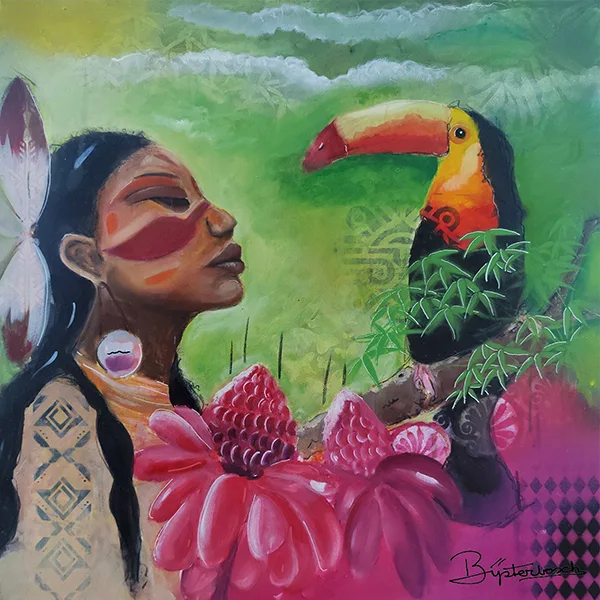
Travel can be a powerful teacher when it is approached slowly. A rainforest does not need to be translated through another culture’s symbols in order to feel alive on a canvas. Its rain, bird calls, shadowed greens, red earth, and dense abundance already offer a world of visual possibility.
The same is true of encounters with communities. Rather than arriving with an image already formed, an artist can make space to observe and listen. Sketch the changing light. Record the shapes of leaves and the movement of water. Notice the colors people choose in everyday life without claiming their visual traditions as your own. Let conversation reshape your assumptions.
This way of working creates art that is personal without being extractive. The resulting piece may hold the emotional memory of a place – its warmth, complexity, generosity, and vitality – while remaining clear about whose story it tells. An artist can say, “This work was inspired by my experience of the forest and the people who welcomed me,” rather than suggesting ownership of a culture they do not belong to.
Collaboration Creates a Deeper Story
When a project directly draws from Indigenous knowledge, craftsmanship, or imagery, collaboration is often the most respectful and creatively exciting path. It may involve commissioning a local artist, inviting a cultural advisor into the process, or developing a collection with makers who retain clear authorship of their own contribution.
Good collaboration is not a quick approval at the end of a project. It makes room for conversation early enough that the work can change. The collaborator should be recognized by name, heard when something feels wrong, and able to define the boundaries of what can be shared. In many cases, the strongest result is not a fusion of styles at all, but a meeting of distinct artistic voices.
For collectors, this creates a richer experience. You are not only bringing a compelling image into your home. You are living alongside a story with names, places, and a traceable creative journey. Context gives an artwork presence. It lets beauty remain beautiful without becoming anonymous.
Credit Is Part of the Artwork
A thoughtful artwork statement can be as vital as the title. It does not need to be academic or overly long. A few honest lines can explain the location, the experience, the people involved, and the choices the artist made.
Avoid vague language such as “tribal-inspired” when a more precise description is possible. If the influence is a particular landscape, say so. If the work was made in dialogue with a named artist or community, acknowledge that relationship clearly, with their permission. If no direct cultural elements were used, explain that the work responds to nature, travel, and personal reflection.
This kind of clarity is not a footnote to the art. It is an act of care toward everyone who encounters it.
Questions Artists Can Carry Into the Studio
Before beginning an artwork connected to a cultural encounter, pause with a few grounding questions. What am I responding to: a visual symbol, a feeling, a place, or a relationship? Is this element mine to use, or is it held within a specific tradition? Have I learned enough to understand its meaning? Could I express the experience through my own visual vocabulary instead?
Then ask a question that can be harder, but more freeing: what would change if I let go of the most recognizable reference? Often, the answer reveals the real heart of the work. Perhaps it is the deep ochre of a path after rain, the tenderness of a shared meal, the gaze of an animal, or the sensation of standing beneath an immense canopy of trees.
Those are lived impressions. They can become vivid, original art because they belong to the artist’s own encounter with the world.
Collecting With Curiosity and Care
Collectors have a quiet but meaningful role in shaping what is valued. When considering work described as Indigenous-inspired, look beyond the immediate visual impact. Ask about provenance, process, collaboration, and the story behind the piece. The goal is not to interrogate every artist, but to welcome transparency as part of the work’s value.
Look for artists who speak with specificity rather than using broad cultural labels. Notice whether the work honors people as contemporaries, not as an imagined past. Consider whether the maker’s language reflects gratitude, learning, and genuine connection rather than spectacle.
It also depends on what you are collecting. Work created by an Indigenous artist carries their authorship and perspective. Work by a non-Indigenous artist may be an honest response to travel, nature, or shared human experience, provided it does not present another culture’s identity as its own. These are different stories, and both deserve to be described truthfully.
At Art-To-Protect, the belief is that art can carry the energy of a journey while holding close to respect for the people and landscapes that make that journey unforgettable. The most lasting artworks do not rush to explain everything. They invite us to look again, feel more deeply, and remain open to what we do not yet know.
Let your next creative encounter begin there: not with the question, “How can I use this?” but with the far more generous question, “How can I honor what I have been allowed to witness?”