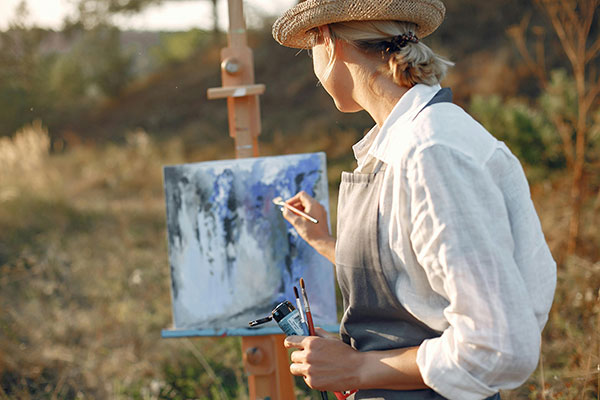
The air in Madagascar does not wait politely for you to begin. It arrives all at once – green, damp, humming, fragrant with leaves and earth, alive with movement you can hear before you can name. Painting in the Madagascar jungle asks something different from an artist than a quiet studio ever will. It asks for attention, humility, and the courage to let the wild interrupt your plans.
This is part of its beauty.
A jungle is never still, and that changes the way a painting is born. Light shifts quickly through the canopy. Colors refuse to stay simple. A branch that looked soft olive one moment becomes electric green in the next flash of sun. Red soil glows against shadow. A bird appears like a secret and vanishes before the brush fully catches up. You are not painting a fixed scene. You are painting an experience of presence.
What painting in the Madagascar jungle really gives you
There is a romantic image people sometimes carry about painting in extraordinary places. They imagine perfect silence, a perfect view, a perfect flow of inspiration. The truth is more alive than that. There may be heat on your skin, insects around your hands, the sound of distant calls in the trees, and the practical challenge of working while everything around you keeps changing.
And still, this is where something honest begins.
Painting in the Madagascar jungle can strip away the habits that make work feel too controlled. In a studio, it is easy to polish every decision before it has a pulse. In the jungle, instinct becomes part of the process. You respond faster. You trust color sooner. You become less interested in perfection and more interested in energy, rhythm, and feeling. The painting starts to breathe because the place itself is breathing.
That matters not only for the artwork, but for the artist.
Many people come to painting with a quiet hunger for reconnection. Not just with technique, but with wonder. Nature has a way of opening that door. Madagascar, with its rare wildlife, layered plant life, and ancient atmosphere, does not offer beauty in a neat, decorative way. It offers beauty that feels mysterious and untamed. For an artist, that can be deeply freeing.
The emotional truth of painting in the Madagascar jungle
What makes this experience unforgettable is not only what you see. It is what begins to move inside you while you are there.
The jungle has a way of making you feel small, but not in a diminishing sense. Small in the sense of being placed back into the living whole. Your pace changes. Your senses sharpen. You notice subtle things again – the curve of a leaf edge, the almost-blue cast of shadow, the strange tenderness in an animal’s gaze, the dignity in a landscape that has existed long before your arrival.
That emotional shift often enters the work before you realize it. A painting made in such a place may carry more than accurate form. It may hold awe, vulnerability, reverence, and surprise. Those qualities cannot be copied from a photograph later in the same way. They come from standing there, sweating a little, listening closely, letting the environment affect your body and your brush.
This is why travel-based painting can become more than an artistic exercise. It becomes a record of relationship.
In Madagascar, that relationship can extend beyond scenery into a deeper awareness of biodiversity, local life, and the fragile richness that deserves protection. When art is created in a place like this, it can become an act of witness as much as an act of expression.
Why Madagascar changes your color palette
Every landscape teaches its own language of color. Madagascar speaks in contrasts.
There is lush green, of course, but it is never just one green. It can be mossy, acidic, velvety, silvered, yellow-lit, or almost black in dense shade. Then there is the earth – rich reds, rusty browns, clay tones that feel warm even when they are cooling at dusk. Add the flicker of bright feathers, pale bark, tropical flowers, water reflections, and sudden open sky, and your usual palette may start to feel too cautious.
That is one of the gifts of this place. It pushes artists beyond predictable choices.
For painters who work in oil, this can be especially thrilling. Oil paint has a sensual depth that suits the jungle’s layered atmosphere. Transparent passages can suggest humidity and distance. Thick, expressive marks can hold the energy of leaves, trunks, and movement. But there is also a trade-off. Oil is slower, heavier, and less forgiving in a field setting than a sketchbook or watercolor kit. Some artists may prefer to gather studies outdoors and build the final painting later. Others thrive on the challenge of direct response.
It depends on how you work, and that is worth honoring. There is no single correct method in a place this alive.
The challenge is part of the art
It would be easy to speak only about inspiration, but difficulty belongs in the story too.
Painting outdoors in a jungle environment is not polished or convenient. Materials react differently in humidity. Surfaces may not stay clean. Your body may tire faster in the heat. You may need to move location because of weather, terrain, or changing light. If you are used to controlling every variable, the experience can feel frustrating at first.
But difficulty has a strange way of revealing what matters most in your process. When comfort is reduced, your attention becomes clearer. You start asking better questions. What is essential in this scene? What feeling do I want to keep? Which marks matter, and which are only habit?
Often the strongest work comes when the artist stops trying to dominate the environment and begins collaborating with it.
That collaboration does not mean giving up skill. It means letting skill become more alive. A looser line may say more than a carefully measured one. A bold color decision may speak more truth than a literal match. The jungle does not ask for stiff accuracy. It asks for presence, sensitivity, and courage.
Painting from observation, memory, and feeling
One of the most beautiful tensions in painting in the Madagascar jungle is the balance between direct observation and inner response.
When you paint on location, you are receiving more information than you can possibly include. The eye sees detail, but the heart selects meaning. That selection is where artistry begins. Maybe it is the elegant shape of a baobab against a changing sky. Maybe it is the flash of a lemur crossing a branch. Maybe it is not an object at all, but a sensation – a density of green, a pulse of life, a silence between sounds.
Later, when the work continues in another setting, memory enters the painting differently than observation does. Memory softens some edges and intensifies others. Feeling becomes a guide. Instead of asking, Did it look exactly like this, you begin asking, Does this carry the truth of what it felt like to be there?
For expressive painters, that question can be more powerful than literal precision.
This is part of why artist-led travel experiences can be so meaningful. They create space not only to see remarkable places, but to translate them through your own hand and emotional language. In that way, the journey becomes personal, even if it is shared.
A creative encounter with biodiversity and purpose
There is another layer to this work that feels especially meaningful in a place like Madagascar. To paint a living ecosystem is to become more aware of its vulnerability.
Biodiversity is not an abstract idea when you are sitting among rare species, listening to a forest that holds delicate balances most people will never witness firsthand. The act of painting can deepen care. You look longer. You notice more. You become attached through attention.
When art is created in support of conservation efforts, that connection gains a beautiful sense of purpose. Creativity stops being separate from the living world and becomes a way of honoring it. For some artists and travelers, that makes the experience even more profound. The work is no longer only about self-expression. It becomes part of a larger gesture of protection, gratitude, and presence.
That spirit lives deeply in the kind of art weeks Bernadet Bijsterbosch organizes – where painting, travel, and care for biodiversity meet in a way that feels both intimate and brave.
Who this experience is really for
Not every artist wants the jungle. That is worth saying honestly.
If you need complete control, silence, and predictable working conditions, this kind of setting may feel more draining than inspiring. But if you long for a creative experience that wakes up your senses and asks more of your courage, Madagascar can offer something rare.
It is especially powerful for artists who feel stuck in repetition, for travelers who want a deeper encounter than sightseeing, and for people who believe art should come from lived experience rather than surface impressions alone. You do not need to arrive as the most technically accomplished painter in the group. What matters more is openness, curiosity, and the willingness to be changed by what you see.
Painting in the Madagascar jungle is not about escaping reality. It is about meeting reality in one of its most vivid forms, brush in hand, heart awake, and senses fully engaged.
If a place can teach you to look again, to feel more bravely, and to paint with greater honesty, it has already given you something lasting before the canvas is even finished.
Bijsterbosch Art organizes immersive art retreats in Madagascar, Costa Rica, and Malaysia, bringing together creatives who wish to connect their practice with purpose. These unique art weeks are developed in collaboration with non-profit organizations dedicated to protecting biodiversity, wildlife, and local communities. Through this exchange, participants are invited not only to create, but also to engage deeply with the environments and causes that inspire their work—fostering a meaningful dialogue between art, nature, and conservation. Join our art weeks and enjoy beautiful Madagascar at the same time.