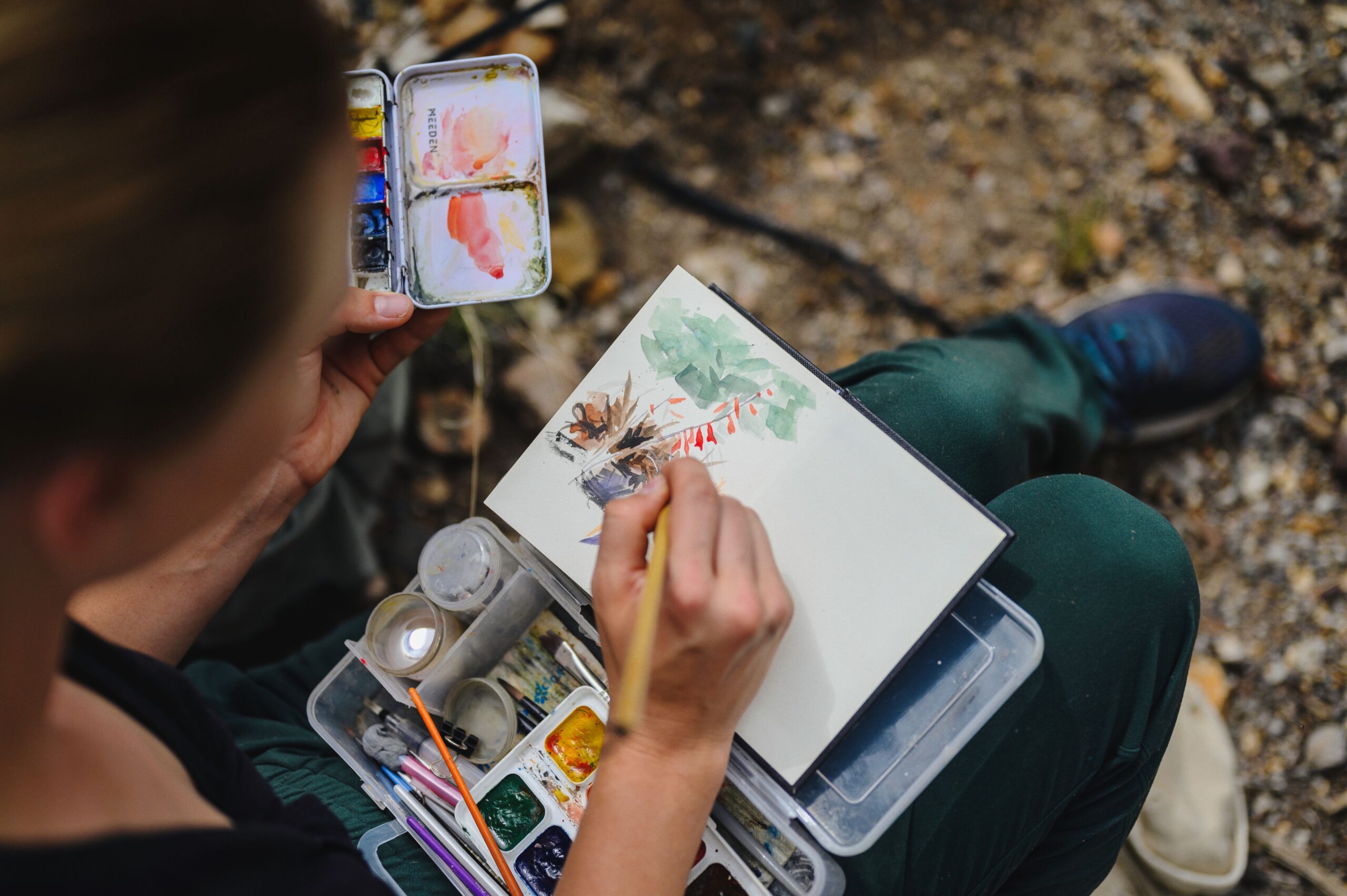
A rainstorm gathers over the forest canopy. A market vendor arranges mangoes in a brilliant, uneven pile. A bird flashes through the branches and is gone before a camera can focus. Travel sketchbooks give these passing moments somewhere to stay. They are not simply records of a journey. They are a way of meeting a place with your full attention.
For artists, travelers, and anyone drawn to the living beauty of the world, a sketchbook can become a private companion. Its pages hold quick lines, color experiments, overheard words, pressed leaves, questions, and memories that may later grow into a painting, a collection, or a new way of seeing. The goal is not to make every page perfect. The goal is to be present enough to notice what makes a place feel alive.
Why Travel Sketchbooks Change the Way You See
Travel can move quickly. There are flights to catch, unfamiliar streets to navigate, weather to work around, and an endless instinct to document everything before it disappears. A sketchbook asks for a different pace. To draw a flower, a fishing boat, or the curve of a mountain ridge, you have to look longer than a glance allows.
That extra time changes the experience. You begin to see the particular green of wet leaves, the patchwork of shadows on a building, or the posture of someone waiting for a bus. A simple scene gains depth because you have given it care. Even a rough pencil drawing can carry more emotional truth than a polished photograph when it brings you back to the heat of the afternoon, the sound of insects, or the feeling of wonder you had in that exact moment.
Travel sketchbooks are also wonderfully free from the pressure of producing finished work. They belong to the middle of the creative process, where curiosity is more valuable than certainty. A page may contain a loose watercolor wash beside a note about local patterns, a color palette inspired by a butterfly wing, and a tiny map showing where you found a view that moved you. This is not disorder. It is the beginning of a visual language.
Choose a Sketchbook You Will Actually Carry
The most beautiful sketchbook is not always the one that travels best. A large, heavy book with luxurious paper can feel inviting at home, yet remain untouched in a backpack. For many journeys, a medium-sized sketchbook is the sweet spot: large enough for expressive pages and small enough to bring along without negotiation.
Paper matters, especially if watercolor is part of your practice. Heavier paper handles washes with more grace, while lighter paper works beautifully for pencil, ink, collage, and soft pastel. If you work in several materials, choose paper that can tolerate a little experimentation rather than demanding a flawless approach.
A hardcover sketchbook offers support when you are drawing outdoors, on a train, or at a cafe table. A softcover version can be lighter and more flexible. Neither is automatically better. The right choice depends on how you like to move through a day and how much equipment you genuinely want to carry.
Keep your materials modest. A pencil, eraser, waterproof pen, compact watercolor set, water brush, and a small cloth can take you surprisingly far. Fewer supplies often create more freedom. When you have only a few colors, you begin to mix, simplify, and make decisions with greater intention.
Let the first page be imperfect
The blank first page can feel more intimidating than an unfamiliar landscape. Solve that gently by giving yourself a small task: write the date, make a color test, draw your breakfast, or paint the sky from a window. The first mark breaks the spell.
A travel sketchbook is not an audition. It does not need to prove that you deserve to call yourself an artist. It is a working place, a field of discoveries. Let smudges, crossed-out lines, and unexpected stains become part of its character.
What to Sketch When a Place Feels Too Big
A destination can seem impossible to capture because there is simply too much to see. Rather than trying to draw the whole landscape, choose one detail that carries the spirit of the moment. It could be a seed pod on a path, a worn doorway, a bowl of fruit, a cloud shape, or the silhouette of a tree against evening light.
Small subjects are not small experiences. They often reveal the character of a place more honestly than a grand panorama. A page of studies of tropical leaves may later remind you of the air, the rain, and the abundant texture of a rainforest far more vividly than a single wide view.
Try returning to one subject more than once. Sketch the same shoreline in morning and late afternoon. Draw a flower as a simple contour, then return to it with color. Watch how an animal moves and make a series of quick gesture drawings rather than waiting for a perfectly still pose. Repetition teaches you more than chasing a finished image.
When drawing people, respect matters as much as observation. Ask before making a close portrait, particularly in intimate settings or community spaces. If conversation is not possible, sketch the broader scene or draw from memory afterward. A thoughtful sketch carries admiration without treating another person’s life as scenery.
Make Space for Words, Not Just Images
The visual page becomes richer when it includes a few written fragments. Note the name of a plant if you learn it. Describe the weather in three words. Write down a color that has no obvious name: river-stone gray, fermented-tea brown, electric leaf green. These notes can become invaluable later, when the image alone cannot hold every sensation.
Words also help you notice your inner response. Perhaps a particular landscape feels expansive, quiet, or charged with energy. Perhaps a conversation changes how you understand a handmade object or a local tradition. Recording these impressions is not about getting the story exactly right. It is about honoring the encounter while it is still fresh.
For artists building larger bodies of work, this combination of sketches and language can reveal patterns. You may find yourself returning to bold red earth, the generosity of shared meals, birds in flight, or the geometry of woven forms. Over time, a travel sketchbook becomes more than a journal. It becomes evidence of what continually calls you to create.
Work With the Reality of the Journey
There will be days when the weather refuses to cooperate, your hands are tired, or there is no quiet place to sit. This does not mean the day is creatively lost. Draw from a window, make thumbnail sketches while standing, collect a few color notes, or spend five minutes drawing an object in your room.
Speed can be a gift. A two-minute sketch teaches you to find the essential gesture. A longer study teaches patience and nuance. Both belong in the same book. The trade-off is simple: if you wait for ideal conditions, you may miss the raw energy of travel; if you only work quickly, you may miss the pleasures of sustained looking. Let the rhythm of the place guide you.
It can also help to separate observation from interpretation. On location, make loose studies and factual notes. Later, perhaps in the evening, allow yourself to respond more freely with imagined color, pattern, or composition. This is where memory and direct experience begin to speak to one another.
Protect the pages without overprotecting them
Humidity, rain, sand, and crowded bags are part of the adventure. A simple elastic band, zip pouch, and backing board can keep your materials in good shape. Yet do not become so protective that the sketchbook remains hidden away. A weathered cover and softly buckled watercolor pages often show that the book has lived a real life beside you.
From Field Notes to Lasting Art
Months after a journey, opening a travel sketchbook can feel like stepping back into a particular light. The pages may inspire a large painting, a textile design, a series of prints, or an entirely new collection. But they do not need to become anything more to be meaningful. Their value begins with the attention they taught you to give.
At Art-To-Protect, the creative journey is rooted in that kind of attentive encounter: listening to landscapes, wildlife, colors, and human stories with an open heart. Art made from lived experience carries a special presence. It invites others not only to see a beautiful image, but to feel the wonder that first moved the artist to make it.
Take your sketchbook somewhere ordinary this week. Sit beneath a tree, at a station, near a window, or on a familiar street. Draw one small thing slowly enough to surprise yourself. The world is already offering you a page worth keeping.