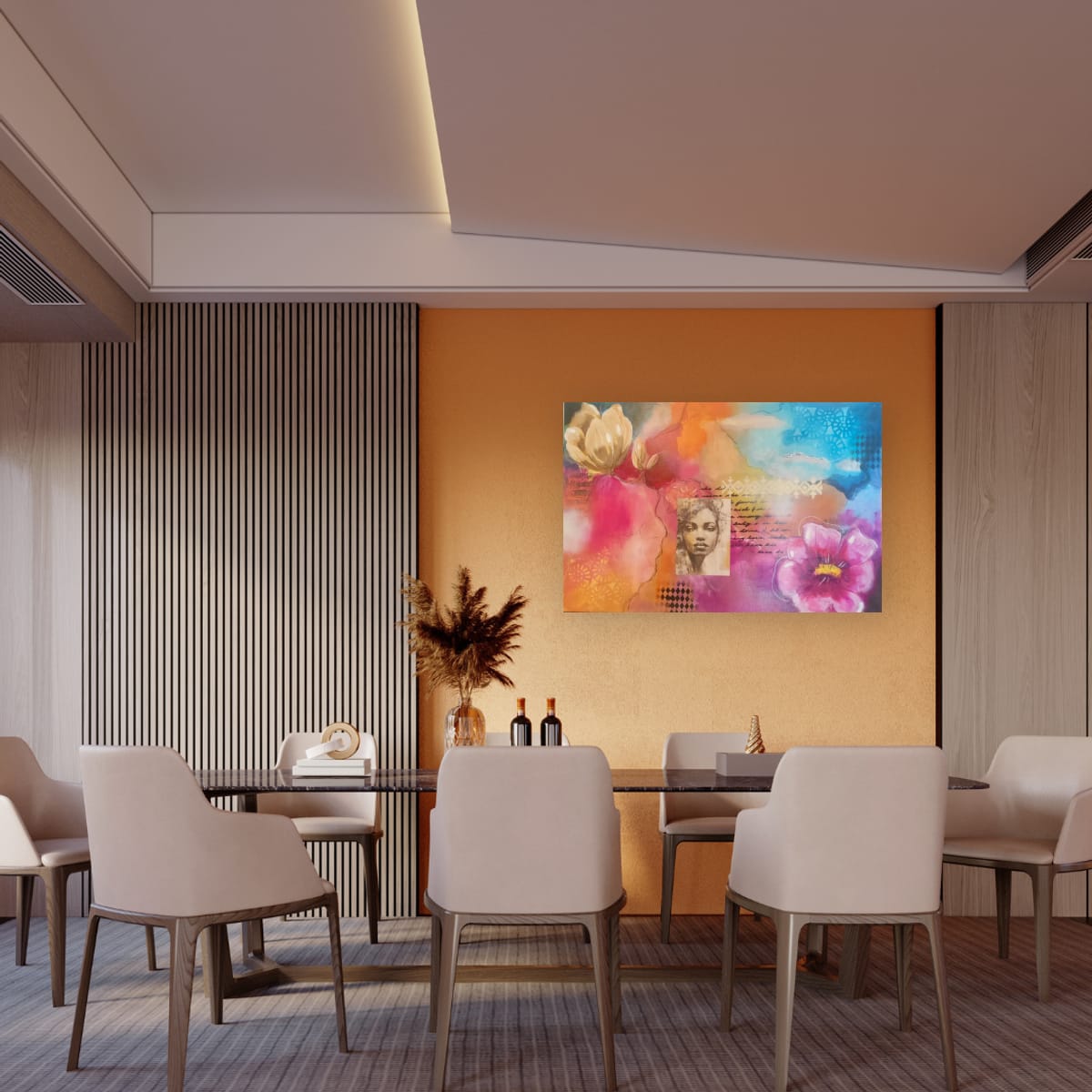
A room can look finished on paper and still feel emotionally silent. Then one abstract painting enters the space, and suddenly there is movement, warmth, tension, memory – something alive. That is why learning how to decorate with abstract paintings is less about following rules and more about understanding what kind of feeling you want to live with every day.
Abstract art has a special power because it does not tell you exactly what to see. It invites you in. One person finds a horizon, another sees weather, another feels courage or stillness. That openness makes it deeply personal, but it also means placement and selection matter. The right work can hold a room together. The wrong one can feel disconnected, even if the colors are technically perfect.
How to decorate with abstract paintings starts with feeling
Before you think about size or palette, begin with emotion. Ask yourself what the space is missing. Is it calm? Energy? Depth? Curiosity? A painting should not be treated like filler for an empty wall. It should bring a pulse to the room, a kind of visual heartbeat that changes how the space is experienced.
This is where many people get stuck. They shop for abstract art by matching a sofa, a rug, or a wall color too literally. Sometimes that works, especially in very controlled spaces, but often it leads to art that behaves politely instead of art that transforms. A better approach is to let the painting either echo the atmosphere already present or gently shift it.
A soft, layered abstract in earthy tones can bring exhale and quiet. A work with bold brushwork and flashes of deep blue, rust, or crimson can create momentum and confidence. Neither is better. It depends on the emotional life you want the room to carry.
Let scale do part of the talking
Scale changes everything. A small abstract painting can feel intimate, almost like a secret. A large one can create immersion. If the artwork is too small for the wall or the furniture around it, the space can feel hesitant. If it is too large, it can become oppressive rather than expressive.
When choosing scale, think about the visual weight of the room, not just the measurements. A painting above a substantial piece of furniture usually needs enough presence to hold its own. In an open space, a larger abstract work can create a strong emotional center without needing extra explanation.
There is also beauty in restraint. A modestly sized painting placed with intention can feel incredibly refined, especially when the surrounding space allows it room to breathe. More is not always more. Sometimes one work with depth says everything.
One statement piece or a conversation of works
Some spaces ask for a single painting that anchors the entire experience. Others come alive through a pair or a series. If you are drawn to multiple abstract works, think about the relationship between them. They do not need to match exactly. In fact, too much sameness can flatten the feeling.
What matters is rhythm. Similar tones, shared energy, or a repeated gesture can create connection without repetition. A group of works can tell a broader story, especially if they carry the feeling of travel, landscape, memory, or changing light. The arrangement should feel like a conversation, not an argument.
Color should guide mood, not just coordination
Color is usually the first thing people notice in abstract art, but its real role is deeper than coordination. Color shapes mood before the mind even begins to interpret form. It can settle the nervous system, spark imagination, or add a needed sense of drama.
If your space already has a strong palette, an abstract painting can either reinforce it or provide contrast. Reinforcement creates harmony. Contrast creates tension and vitality. Both can be beautiful. It depends on whether you want the art to blend into the atmosphere or awaken it.
Neutrals are often misunderstood in abstract work. They are not automatically safer or easier. A painting in soft whites, sand, clay, charcoal, and smoke can be profoundly moving if it has depth, texture, and sensitivity. On the other hand, color-rich abstracts can feel surprisingly balanced when their intensity is grounded by composition.
Try not to reduce color to matching. A painting with one unexpected note – saffron, forest green, ultramarine, coral – can give the entire room more soul. That kind of tension often feels more human than perfect coordination.
Placement matters because energy is directional
How to decorate with abstract paintings is also about where the eye lands first and how it travels. Art affects movement. It can draw you inward, lift your gaze, soften a transition, or create a pause in a busy area.
A painting placed at eye level usually feels most natural, but the architecture of the room and the emotional purpose of the piece matter too. Lower placement can feel grounded and intimate. Higher placement can create distance. Neither is wrong, but the effect is different.
Light plays a role as well. Natural light can bring texture and subtle color shifts to life across the day, while poor lighting can make a nuanced painting feel flat. If the work has delicate tonal changes or layered oil textures, those qualities deserve enough light to be seen and felt.
Give the work space to breathe
One common mistake is crowding an abstract painting with too many surrounding objects. Because abstract art often relies on gesture, atmosphere, and silence as much as subject, it needs visual breathing room. That does not mean emptiness for its own sake. It means allowing the painting to hold its own field of presence.
If everything around it is equally loud, the work can lose its emotional clarity. When there is space around a painting, even a quiet one can become magnetic.
Choose art that leaves room for your own story
Abstract paintings endure because they keep unfolding. You do not outgrow them quickly when they are chosen for emotional resonance rather than trend. The best ones seem to change with your seasons of life, your light, even your memories.
This is especially true for people who are drawn to travel, nature, and cultures that expand the heart. An abstract painting can carry traces of landscape, movement, wildlife, weather, ritual, or human presence without describing any of them literally. That is part of its beauty. It makes room for your own associations.
When you live with a work over time, you begin to notice what it gives back. Some paintings offer peace after a long day. Others challenge you in the best way. Others remind you of distant places, salt air, jungle greens, red earth, or the feeling of being changed by what you have seen in the world. Those are not small things. They are part of what makes art worth living with.
Original work and prints create different experiences
There is no single right way to collect abstract art. Original paintings have a presence that comes from the artist’s hand, the body of the paint, and the one-time nature of the gesture. You can often feel the decisions, the revisions, the courage. That physicality matters.
Prints, on the other hand, open the door for more people to live with meaningful art. A beautiful print can still carry color, composition, and emotion in a powerful way. The choice depends on budget, intention, and how closely you want to live with material texture.
For some collectors, one original painting becomes a lifelong piece, while prints allow them to build a broader visual story around it. For others, prints are the beginning of a relationship with an artist’s world, and later they move toward originals. Both paths are valid.
Trust what stays with you
If you are deciding between several abstract paintings, notice which one lingers in your mind after you leave it. Usually that is the one. Not always, but often. The work that keeps calling you back is rarely doing so by accident.
A meaningful abstract painting does more than complete a wall. It changes the emotional temperature of a space. It introduces depth, wonder, and a sense of inner life. That is true whether the work is bold and expansive or soft and contemplative.
At Bijsterbosch Art, this belief sits at the heart of the work itself – that art is not there to behave, but to bring beauty, freedom, and feeling into daily life. When you choose an abstract painting with that kind of honesty, the space begins to speak back to you.
Let the painting be more than an accessory. Let it be the piece that reminds you, quietly and every day, that beauty is something you can live inside.