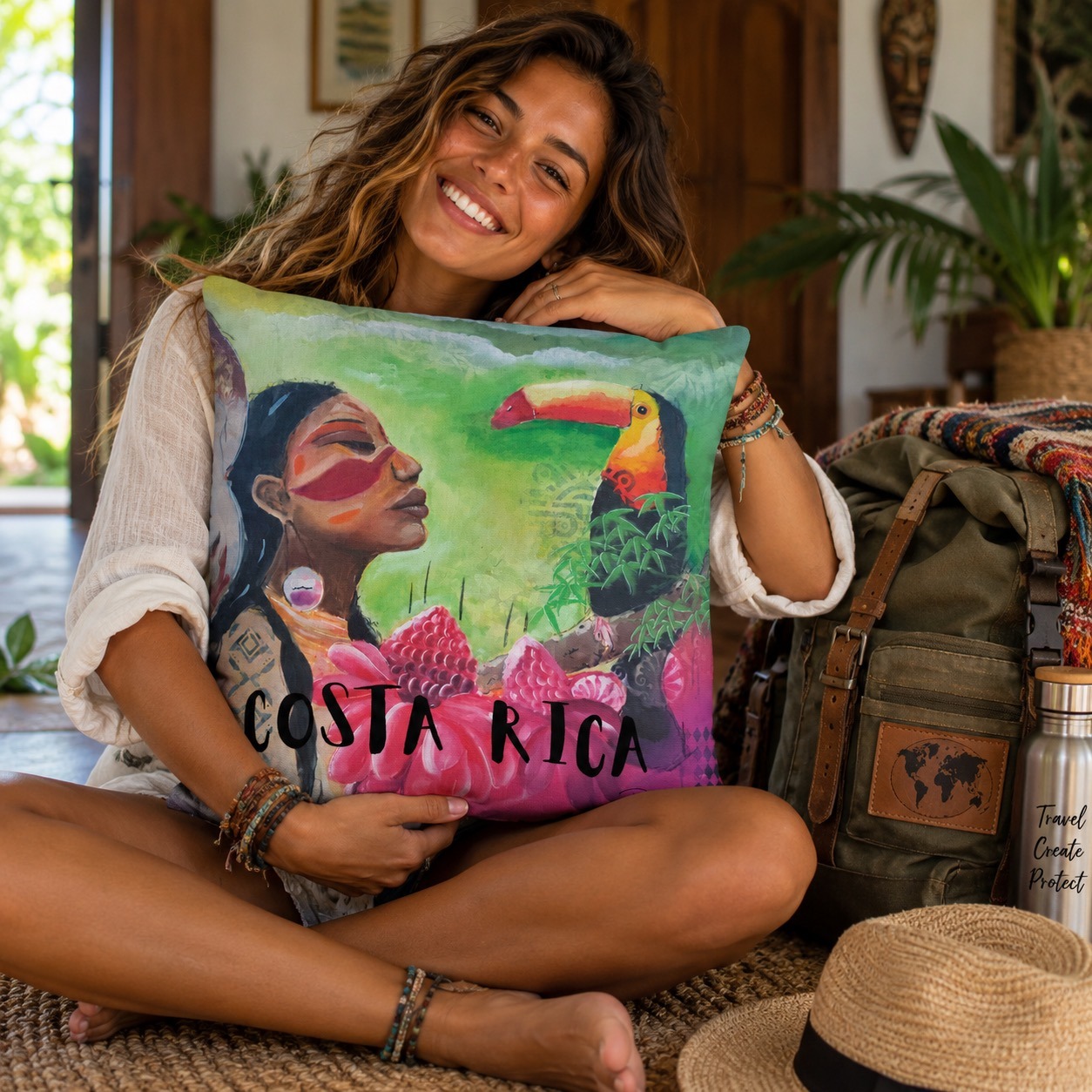
A meaningful artist led conservation trip example does not begin with a sketchbook or a camera. It begins with listening. Before an artist creates a single image of a scarlet macaw, a rainforest canopy, or a winding river, there is an invitation to understand the place, meet the people caring for it, and recognize that every landscape holds stories beyond what a visitor first sees.
For ART-TO-PROTECT, this is where art, travel, and conservation become more than a beautiful idea. An artist-led journey can create work that carries the feeling of a destination while helping customers, collectors, and retail partners connect with the living world behind each design. When the trip is thoughtfully planned, the resulting collection can honor local knowledge, support conservation partners, and give people a tangible way to carry that connection home.
An Artist-Led Conservation Trip Example: Costa Rica
Imagine a small group arriving in Costa Rica during the early morning hours, when mist rests in the forest and the calls of tropical birds carry through the trees. The purpose is not to collect dramatic images as quickly as possible. It is to spend time with a local conservation organization, learn about its work, and allow the rhythms of the landscape to shape the creative process.
The group includes an artist, a conservation guide, local hosts, and a representative from the partner organization. Their first day is intentionally unhurried. They walk a forest trail, pause near native plants, and learn why connected habitats matter for wildlife moving across the region. The artist takes notes on colors, patterns, sounds, and small details that may never appear literally in a final painting: the soft geometry of a leaf, the bright movement of a butterfly, the warm red earth after rain.
That evening, the group gathers for a conversation rather than a presentation. Local conservation staff share what they are protecting, what progress looks like in their particular landscape, and how visitors can participate respectfully. If community members choose to share cultural traditions, stories, or creative practices, those exchanges are approached with care. Permission matters. Attribution matters. Fair compensation matters. Inspiration should never become extraction.
The following days balance observation with contribution. Depending on the partner and the season, participants might help with a suitable hands-on activity, join an educational walk, or learn how restoration work is monitored over time. The artist is not positioned as the hero of the story. The artist becomes a witness, a learner, and eventually a translator of experience through color, line, texture, and composition.
From Field Notes to a Collection With Meaning
Back in the studio, the trip becomes something new. A painting may be inspired by the layered green of the forest, but its story can also acknowledge the people who protect that habitat every day. A textile pattern might echo the wings of a native species while inviting customers to learn why biodiversity needs connected, cared-for places to thrive.
This is the essential difference between travel-inspired décor and art with purpose. The work is not only about what was seen. It is about what was learned, felt, and carried forward responsibly.
An artist might create a limited collection of prints, scarves, notebooks, or small objects for museum shops, zoo stores, galleries, airport retailers, and destination boutiques. Every product can include a concise story about the landscape that inspired it and the conservation partnership connected to it. A portion of profits can then support the agreed conservation work, with clear communication about how the commercial model contributes.
The collection does not need to make oversized promises to be powerful. A transparent message such as, “This design was inspired by time spent learning from conservation partners in Costa Rica, and a portion of profits supports their work,” is both honest and inviting. It gives the customer a real place in the story without suggesting that one purchase alone solves a complex challenge.
Why the Artist’s Perspective Matters
Conservation information is often shared through facts, field reports, and scientific images. These are essential. Yet art reaches another part of us: the part that remembers a color, feels wonder at an animal’s presence, or pauses because a familiar natural form has been seen in a new way.
An artist can help people notice what they may otherwise pass by. A painted frog is not a scientific inventory. A hand-drawn forest map is not a management plan. But both can spark attention, affection, and curiosity. Those feelings can lead someone to ask better questions, visit a nature center, support a conservation organization, or choose a gift that reflects their values.
For retailers, that emotional bridge has practical value as well. Visitors increasingly seek products with a story they can share. A collection born from respectful field experience offers more than a visual motif. It offers a conversation between artist, destination, conservation partner, and customer. That story can bring greater depth to a museum shelf, a zoo shop display, or a travel retail assortment.
Care Makes the Difference
Not every conservation trip should follow the same model. A remote habitat may not be appropriate for group visits. A conservation team may be in a particularly busy field season. Some species should not be closely approached, photographed, or publicly located. In those cases, the most responsible creative choice may be to work from guided observations, existing partner-approved material, or stories shared at a distance.
A well-designed trip also accounts for the needs of the people hosting it. Local guides, artists, naturalists, and community members should be recognized as skilled collaborators, not treated as background to a visitor’s experience. The schedule should leave room for rest, reflection, and changing weather. The group size should remain manageable. And any content created during the trip should be reviewed with care when it includes sensitive places, cultural knowledge, or partner stories.
These considerations do not make the experience less inspiring. They make it more real. Respect creates the conditions for trust, and trust gives art a deeper foundation.
What Participants Bring Home
The most lasting outcome may not be the artwork itself. It may be a changed way of seeing. The artist returns with a richer visual language. The traveler returns with a more personal relationship to a place. The conservation partner gains a creative ally who can help share its mission with new audiences. And the customer who later chooses the finished piece becomes part of a wider circle of support.
That circle can extend far beyond Costa Rica. An artist-led conservation journey might be shaped around rainforest biodiversity in Malaysia, remarkable habitats in Madagascar, or another destination where local partners welcome meaningful collaboration. The location matters, but the principles remain the same: learn before interpreting, create with permission, tell the story accurately, and ensure the partnership creates value for the people and places at its heart.
Art cannot replace long-term conservation work. What it can do is make that work visible in a human, memorable way. It can turn a moment of wonder into a design, a design into a conversation, and a conversation into support.
The next time a painting, print, or beautifully made object reminds you of a wild place, pause with the story behind it. Ask who inspired it, who benefits from it, and what it invites you to protect. That small moment of curiosity can be the beginning of a more connected kind of collecting.